DocETL: Declarative & Agentic Map-Reduce





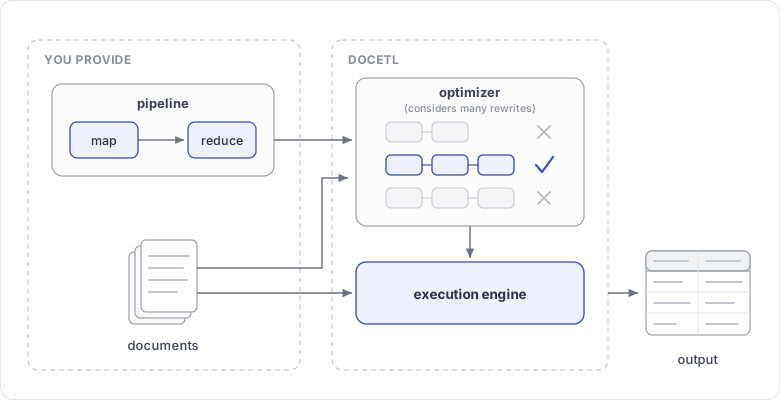
DocETL helps you process large collections of data (structured and unstructured) with LLMs. You write each operation in natural language, e.g., "pull out every complaint in this ticket," and DocETL
- provides the operators you need (map, reduce, filter, and more) and orchestrates them, parallelizing work across your data,
- optimizes your pipeline automatically, swapping models, rewriting prompts, decomposing operations, and replacing subtasks with code wherever possible, to raise accuracy and cut cost, and
- returns tables, easy to query in your favorite database.
Without DocETL, you write each LLM call yourself, wire them together, and tune the result for accuracy, cost, and latency by hand.
Getting Started
Write pipelines in Python, or in YAML if you prefer low-code / no-code. (There is also a pandas accessor for quick one-off operations on DataFrames.)
import docetl

docetl.default_model = "gpt-4o-mini"

# What themes come up across customer interviews?
interviews = docetl.read_json("interviews.json")

# Extract themes from each interview
interviews = interviews.map(
    prompt="List the themes discussed in this interview: {{ input.transcript }}",
    output={"schema": {"themes": "list[str]"}},
)

# Synthesize the top themes across all interviews
themes = interviews.reduce(
    reduce_key="_all",
    prompt="""Identify the top recurring themes across these interviews:
{% for item in inputs %}- {{ item.themes }}
{% endfor %}""",
    output={"schema": {"top_themes": "list[{name: str, description: str, num_mentions: int}]"}},
)

results = themes.collect()  # nothing runs until this line
collect() returns the result rows as a list of dicts (use
themes.to_pandas() for a DataFrame); results[0]["top_themes"] looks like:
[
    {"name": "onboarding friction", "description": "confusion during first-week setup", "num_mentions": 12},
    {"name": "pricing transparency", "description": "unclear billing and plan limits", "num_mentions": 8},
    ...
]
See the User Guide for details.
Define the same pipeline declaratively, then run it from the CLI:
default_model: gpt-4o-mini
datasets:
  interviews:
    type: file
    path: interviews.json
operations:
  - name: extract_themes
    type: map
    prompt: "List the themes discussed in this interview: {{ input.transcript }}"
    output:
      schema:
        themes: list[str]
  - name: synthesize_themes
    type: reduce
    reduce_key: _all
    prompt: |
      Identify the top recurring themes across these interviews:
      {% for item in inputs %}- {{ item.themes }}
      {% endfor %}
    output:
      schema:
        top_themes: "list[{name: str, description: str, num_mentions: int}]"
pipeline:
  steps:
    - name: analyze
      input: interviews
      operations: [extract_themes, synthesize_themes]
  output:
    type: file
    path: themes.json
docetl run pipeline.yaml
See the tutorial for a complete walkthrough.
Project Origin
DocETL is built at UC Berkeley by the EPIC Data Lab and the Data Systems and Foundations group.