Documentation
Overview
Actor-Gatherer is a framework for agent design where agents context is managed proactively and externally using a Gatherer component. ag is a cli tool that turns any coding agent (Claude Code, Codex, OpenCode or Pi) into an actor-gatherer agent. The agent performing your tasks is called an Actor, and a Gatherer component manages the context of all actors connected to it. The Actors share all their messages with the Gatherer, and before every LLM call, they ask the Gatherer for their context. The Gatherer decides the context the model gets based on the current conversation, plus what matters from earlier history, from other agents, and from the environment.
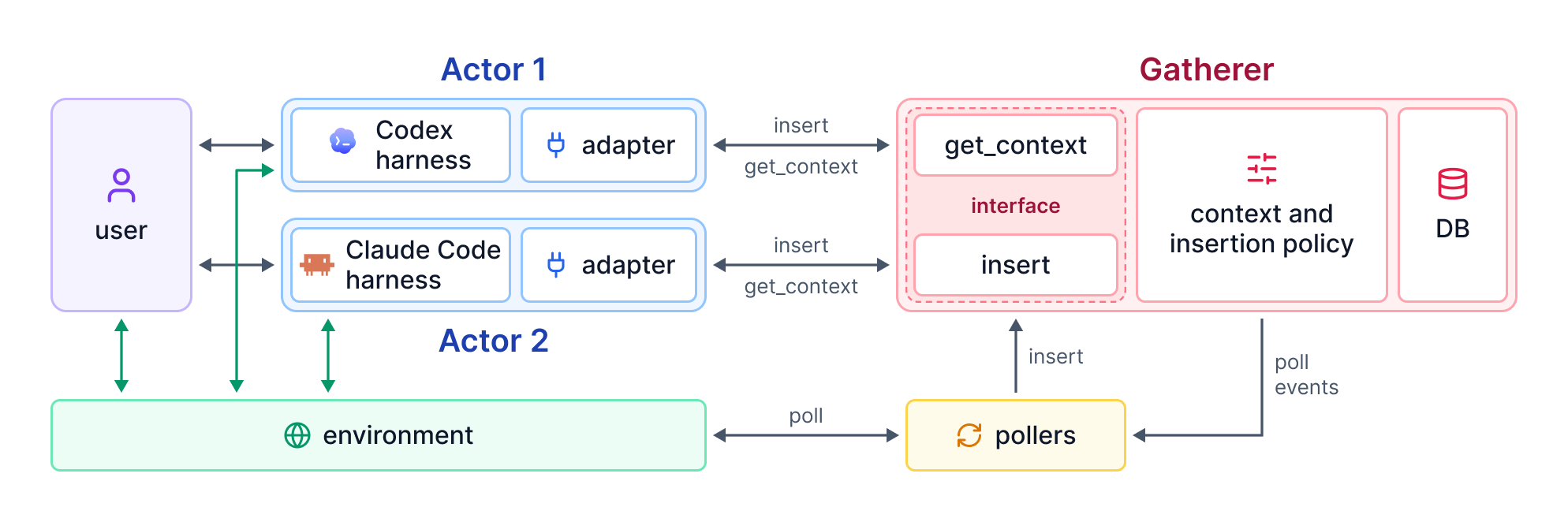
The Gatherer is a server that many Actors talk to, and the Actors can come from different coding harnesses. An Actor is a harness plus its adaptor, which turns the harness's messages into events and the Gatherer's context back into messages. Each Actor uses two calls on the Gatherer:
insertgives the Gatherer what the Actor has seen and done.get_contextruns before each model call, and returns the context the model gets.
Pollers bring in information from the environment, such as files changed under the working directory. The Gatherer asks them for new events, and they insert those events like an Actor would. A context management policy inside the Gatherer then decides what context each Actor gets, using everything it has gathered from every Actor and from the environment.
ag currently uses:
- Adaptors:
ClaudeAdaptor,CodexAdaptor,OpencodeAdaptorandPiAdaptor, each with the launcheraguses to start that harness connected to the Gatherer. - Pollers:
FileChangePoller, which reports changes to the files the conversation names, under the agent's working directory, since it last looked. - Context Policy:
ProactiveContextManager, which searches earlier history in the background, and adds what other sessions asked for and what changed in the environment.
The framework is extensible. Add a new harness by defining an adaptor for it, new context policies for context management, and pollers that track other information in the environment. See Extending ag.
Install
You need Python 3.11+ and the harness you want to run on your PATH. Install ag from PyPI:
pip install actor-gatherer
Or from source:
git clone https://github.com/ucbepic/actor-gatherer && cd actor-gatherer
pip install -r requirements.txt        # `ag` from this clone, editable, with every dependency
Set the Gatherer's LLM
The Gatherer uses LLMs to manage the context of Actors, so you must set the model the
Gatherer uses. It can be an API-based model, called through
LiteLLM. Name it as provider/model, and set that provider's API key, e.g.,
ag model openai/gpt-6-sol                    # "provider/model"; the key from OPENAI_API_KEY
export OPENAI_API_KEY=...

ag model gemini/gemini-3.8-flash             # or a Gemini model; the key from GEMINI_API_KEY
export GEMINI_API_KEY=...
Or it can be a coding agent, such as Claude Code or Codex, named as
ag model claude-code/sonnet
ag model codex/gpt-6-sol
which runs Claude Code or Codex for the Gatherer. To use Codex, make sure OpenAI's Codex SDK is installed:
pip install openai-codex
To check the model that is set:
ag model
Quickstart
Put ag --gatherer NAME in front of the agent command you would normally run.
ag --gatherer demo claude                                # Claude Code
ag --gatherer demo codex exec "fix the tests"            # Codex
ag --gatherer demo opencode run "add a --verbose flag"   # OpenCode
ag --gatherer demo pi                                    # Pi
Agents join the gatherer specified (demo above). Agents with the same gatherer
share information with each other, whichever harness runs them (see the example). Agents in
different gatherers don't share context and each gatherer keeps its own history.
For example, the first two agents below share information; the third, in a gatherer of its own, sees neither of them:
ag --gatherer frontend claude                            # shares with the Codex below
ag --gatherer frontend codex                             # shares with the Claude Code above
ag --gatherer backend codex                              # shares with neither
Without --gatherer, a session joins the gatherer default:
ag codex # the same as: ag --gatherer default codex
Use --gatherer . to create a new, unnamed gatherer. Agents created
this way don't share context with other agents:
ag --gatherer . codex
To see every gatherer:
ag gatherers # each one's policy, pollers, event count, last activity
Every option and command is in ag CLI interface.
ag CLI interface
ag is the command line that runs a harness with the Gatherer, and manages the gatherers and settings it keeps. Its options go before the harness's name, and everything after the name is passed to the harness unchanged.
Options
By default every agent you start with ag, from any harness, joins one shared gatherer named default ([cli] gatherer), each session as its own channel.
| flag | meaning |
|---|---|
--gatherer NAME |
Join the named gatherer, created if it does not exist. Overrides [cli] gatherer. |
--gatherer . |
Give each session a new gatherer of its own, named after the session. |
--policy P |
Create the gatherer with policy P. Refused if it exists with another policy. |
--poller X |
Create the gatherer with poller X (repeatable). |
--no-pollers |
Create the gatherer with no pollers. |
--dry-run |
Print the command and environment that would run, and run nothing. |
A new gatherer takes its policy and pollers from the defaults in config.toml, or from --policy and --poller when given. They are recorded in ~/.ag/gatherers/<name>/gatherer.toml, where you can change an existing gatherer's pollers, or override its policy's options under [options]. A gatherer's policy cannot change once it is in use; to try another, start a new gatherer.
The gatherer is chosen on every model call; it is not stored with the session. To resume a session in a named gatherer, name it again: ag --gatherer demo codex resume <id>. Without --gatherer demo, the resumed session goes into default.
Commands
| command | does |
|---|---|
ag <harness> [args] |
Run the harness with the Gatherer. |
ag model [NAME] [--api-base URL] [--key-env VAR] |
Show or set the LLM the Gatherer calls. |
ag config |
Show where the settings are, and what each harness resolves to. |
ag status / ag stop |
List / stop the proxies ag started. |
ag gatherers |
List every gatherer: its policy, pollers, events and last activity. |
ag show <gatherer> |
Show a gatherer's resolved settings. |
ag new <gatherer> [--policy P] [--poller X ... | --no-pollers] |
Create a gatherer ahead of use. |
ag home list |
List every available policy and poller, and any problem. |
ag home path |
Print the home directory. |
The home directory
Everything ag keeps is in one directory, ~/.ag (set AG_HOME to move it). Each gatherer has a directory of its own, with its settings and its database:
~/.ag/
├── config.toml                     every setting: policies, pollers, the LLM, harnesses
├── plugins/                        your own policies and pollers (Python files)
├── gatherers/<name>/               one directory per gatherer:
│   ├── gatherer.toml               its policy, its options and its pollers
│   └── context.db                  its database (SQLite): every event, and every context it sent
├── hook_server/<port>.json         the proxies ag started (Claude Code, Codex)
└── logs/
    ├── gatherers/<name>/server.log what each model call came to
    ├── gatherers/<name>/worker.log the gatherer's background builds
    ├── <harness>_server.log        each Gatherer server's own output
    ├── hook_servers/<port>.log     each proxy's output
    └── llm/                        one JSON file per LLM call the policies make
A gatherer's database records exactly what the model was sent on every call, so any context can be audited later. ag gatherers lists every gatherer, and ag show <gatherer> shows one's settings.
Configuration
Every setting is in ~/.ag/config.toml, created the first time you run ag with every default written out. A command-line option overrides the setting it names (--gatherer over [cli] gatherer), and so does an AG_* environment variable (AG_LLM_MODEL over [policies.llm] model). The file has these tables:
[policies]                     # the default policy
[policies.llm]                 # the LLM the policies call
[policies.available.<name>]    # the catalog: every policy a gatherer may use

[pollers]                      # the default pollers
[pollers.available.<name>]     # the catalog: every poller a gatherer may use

[cli]                          # the ag command: the default gatherer
[cli.harnesses.<name>]         # each harness ag can run
ag config, ag home list and ag show show how the settings resolve (see Commands).
[policies]
This is the [policies] part of the config.toml that ag writes on first run. default names the policy a new gatherer gets. Below it is the catalog, one [policies.available.<name>] entry per policy a gatherer may use: the shipped proactive_context_manager, and two commented-out entries to copy, a variant of it with other options (pcm_small) and a policy of your own from ~/.ag/plugins/ (mine).
[policies]
default = "proactive_context_manager"   # the policy a new gatherer gets when none is named

# ---------------------------------------------------------------- available policies
# Every policy a gatherer may run.

# Earlier history as sections, built in the background; file-change notices; the user's
# requests to the other channels, shown during a task.
[policies.available.proactive_context_manager]
class = "ag.ag_policies.proactive_context_manager:ProactiveContextManager"

# A variant: the same class, other options. Its budgets must add up to less than its
# max_context_tokens; the rest is headroom before the next build.
# [policies.available.pcm_small]
# class = "ag.ag_policies.proactive_context_manager:ProactiveContextManager"
# [policies.available.pcm_small.options]
# max_context_tokens = 100000
# all_task_tokens = 30000
# parallel_index_tokens = 15000
# keep_temporal_relevant_tokens = 7500
# keep_task_relevant_tokens = 7500
# keep_previous_task_tokens = 7500
# keep_so_far_tokens = 7500
# keep_pinned_tokens = 5000

# Your own: a Policy subclass (or a factory) in plugins/mine.py, built with whichever of
# format=, llm=, options= it takes.
# [policies.available.mine]
# file = "mine.py"
# class = "MyPolicy"
# options = {}
Each entry under [policies.available.<name>] makes a policy available under that name:
| key | meaning |
|---|---|
class |
"module:Class" for an importable class; or just "Class" together with file or module. A factory function works too. |
file |
A Python file in ~/.ag/plugins/ that defines class. |
module |
An importable module that defines class. |
options |
Options passed to the policy. A gatherer's own [options] in its gatherer.toml are applied on top of these. |
Two entries can name the same class with different options; each is a separate policy, and a gatherer picks one by name (ag --gatherer small --policy pcm_small codex).
[policies.llm]
The LLM the policy calls (to split history into tasks, summarize them, and rank them). There is no default model; set one here or with ag model. The model's name decides how it is called:
- A coding agent,
claude-code/<model>orcodex/<model>(e.g.claude-code/sonnet): runs Claude Code (claude -p) or Codex for each call, on that agent's own login, with its tools and default instructions out of the way. No API key is needed, and every call counts against the subscription's limits. Codex models need OpenAI's Codex SDK:pip install openai-codex;agrefuses to run without it. - Any other name,
provider/model(e.g.gemini/gemini-3.8-flash): called through LiteLLM, with the provider's API key.
# The LLM the policies call. `model` is a coding agent on its own login,
# claude-code/<model> or codex/<model>, or any other "provider/model" through LiteLLM,
# e.g. "gemini/gemini-3.8-flash". `api_base` and `key_env` are for LiteLLM only; without
# `key_env`, the key is the provider's own variable, e.g. GEMINI_API_KEY.
[policies.llm]
model = ""                              # required: no default (AG_LLM_MODEL)
# api_base = "http://127.0.0.1:4011/v1" # a LiteLLM proxy, or any OpenAI-compatible endpoint (AG_LLM_URL)
# key_env = "LITELLM_KEY"               # the variable holding the key (AG_LLM_KEY)
| key | for | default | meaning | overridden by |
|---|---|---|---|---|
model |
all | none | The model: claude-code/ag warns at launch and every Gatherer call fails. |
AG_LLM_MODEL |
api_base |
LiteLLM | the provider's | Send every call to this server instead. | AG_LLM_URL |
key_env |
LiteLLM | the provider's variable | The environment variable that holds the API key. | AG_LLM_KEY (the key itself) |
claude_command |
claude-code | "claude" |
The Claude Code executable, found on PATH. |
|
codex_command |
codex | "codex" |
The Codex executable, found on PATH. |
|
log_prompts |
all | false |
Keep each call's system text and prompt, whole, in ~/.ag/logs/llm/. Usage, timing and the answer are always logged. |
|
class |
your own | none | An LLM implementation of your own, named like a policy's class (with file or module if needed), instead of the two above. |
The Gatherer's own calls to Claude Code or Codex run without ag's environment, so they never come back through ag.
[pollers]
This is the [pollers] part of the config.toml that ag writes on first run. default lists the pollers a new gatherer gets. Below it is the catalog, one [pollers.available.<name>] entry per poller a gatherer may list: the shipped file_changes, and a commented-out entry to copy for a poller of your own from ~/.ag/plugins/ (tickets).
[pollers]
default = ["file_changes"]              # the pollers a new gatherer gets, whatever its policy

# ---------------------------------------------------------------- available pollers
# Every poller a gatherer may list: where its events come from outside the conversation.

# Files changed under the agent's working directory, as environment_update events.
[pollers.available.file_changes]
class = "ag.ag_pollers.file_changes:FileChangePoller"
args = { root = "{cwd}" }

# Your own: a Poller in plugins/tickets.py, built with its args.
# [pollers.available.tickets]
# file = "tickets.py"
# class = "TicketPoller"
# args = { ticket = "4123", cwd = "{cwd}" }
An entry under [pollers.available.<name>] takes class, file and module as for policies, and args: the arguments the poller is built with. In a string argument, {cwd} is the agent's working directory, {gatherer} the gatherer's name and {home} the ag home; ~ is expanded. A poller whose arguments need {cwd} is skipped when the request has no working directory.
A gatherer's pollers must output event types its policy accepts; ag checks this before each run (see Events, event types and properties).
[cli]
# The gatherer every run files into ("." for one per harness session); `ag --gatherer NAME`
# (or `--gatherer .`) overrides it for one run.
[cli]
gatherer = "default"
--gatherer overrides it for one run (see Options).
[cli.harnesses.<name>]
ag knows a harness only from its entry here, which names its launcher and its adaptor and holds the launcher's settings. ag <name> runs it. How each shipped harness is connected is in The shipped harnesses.
[cli.harnesses.claude]
launcher = "ag.integrations.harnesses.claude.setup.launch:ClaudeLauncher"
adaptor  = "ag.integrations.harnesses.claude.adaptor.adaptor:ClaudeAdaptor"
command  = ["claude"]       # the Claude Code to run
upstream = ""               # where its API calls go ("": ANTHROPIC_BASE_URL as set, else Anthropic's)
port     = 4113             # the first port a hook server tries
log_dir  = ""               # if set, each request the hook changed, before and after
trace_root = ""             # if set, every model call there: the request as the model got it, and its answer
system_messages = ""        # "keep" / "user" for every request ("": chosen by each request's model)
env      = {}               # extra environment for Claude Code (and nothing else)
| key | harnesses | default | meaning |
|---|---|---|---|
launcher |
all | each harness's own | the launcher class, "module:Class" |
adaptor |
all | each harness's own | the adaptor class: "module:Class", or "path.ts:Export" |
command |
all | each harness's own | the command that runs the harness |
provider |
codex | "" |
the model provider to hook ("": the one codex would use) |
port |
codex, claude | 4013 (codex) / 4113 (claude) |
the first port a hook server tries |
log_dir |
codex, claude | "" |
if set, each request the hook changed, before and after |
env |
all | {} |
extra environment for this harness only |
upstream |
claude | "" |
where its API calls go ("": ANTHROPIC_BASE_URL as set, else Anthropic's) |
trace_root |
claude | "" |
if set, every model call there: the request as the model got it, and its answer |
system_messages |
claude | "" |
"keep" / "user" for every request ("": chosen by each request's model) |
Environment variables for one harness, set when you run it:
| variable | harness | default | meaning |
|---|---|---|---|
AG_CODEX_AG_ROLE |
codex | developer |
user: send the Gatherer's messages to Codex as user messages instead of developer messages. |
AG_PI_TIMEOUT_MS |
pi | 300000 |
How long a model call waits for the Gatherer. |
AG_PI_COMPACTION |
pi | off |
allow: keep Pi's own compaction on. |
AG_OPENCODE_TIMEOUT_MS |
opencode | 300000 |
How long a model call waits for the Gatherer. |
AG_OPENCODE_COMPACTION |
opencode | off |
allow: keep OpenCode's own compaction on. |
Other environment variables
| variable | default | meaning |
|---|---|---|
AG_HOME |
~/.ag |
The home directory: settings, gatherers, logs. |
AG_PYTHON |
python3 |
The Python that runs the Gatherer's server. The Claude Code and Codex proxies default to the Python they run in. |
AG_LLM_MODEL |
[policies.llm] model |
The Gatherer's model. |
AG_LLM_URL |
[policies.llm] api_base |
Where the Gatherer's LiteLLM calls go. |
AG_LLM_KEY |
the variable key_env names | The API key for those calls. |
AG_GATHERER |
none | The gatherer, for the Pi extension and the OpenCode plugin when run without ag. Ignored under ag: use --gatherer. |
AG_ADAPTOR |
set by ag | The adaptor the Pi extension or OpenCode plugin loads, as "path.ts:Export". |
Extending ag
The framework is built to be extended in three places. A context policy decides what
context each model call gets. A poller brings in information from the environment. An
adaptor, with a launcher, connects a new harness. Each is a class you name in
config.toml; nothing else in ag needs to change. Policies and pollers can live in
~/.ag/plugins/, or in any importable package.
Events, event types and properties
Everything the Gatherer stores is an event: a user message, the model's answer, a tool call, a tool's output, a file change. An event carries an opaque JSON payload, which the Gatherer stores and returns exactly as given, and has an event type. It may also carry an id (so a re-sent event is stored once), a text (what the policy reads of it, without the harness's metadata), and a token cost.
Event types are the contract between the three extension points. A policy declares the
types it accepts (Policy.event_types); an adaptor and a poller each declare the types
they output. ag refuses to run when an output is not among the policy's types.
An event type also declares properties: named values its events carry beside the payload, each required or not. The store keeps one column per property, refuses an event that lacks a required one or carries one its type does not declare, and filters by them when a policy asks. Three are in use:
channel: the session an event belongs to. The harness side sets it on every event and on every read. An event without a channel (such as a poller's) is visible from every channel.cwd: the agent's working directory, set from the request, and by the file poller to the directory it watched.poller: which of the gatherer's pollers an event came from (its name in the catalog).
Adaptors and pollers declare which properties they set, and ag also checks those against
the policy's event types.
The types proactive_context_manager accepts are:
| type | events of this type |
|---|---|
user_message |
A request from the user; opens a turn. |
agent_message |
The model's answer. |
tool_call, tool_output |
A request to run a tool, and its result. |
context |
Text the harness puts in front of the model (instructions, injected context, compaction summaries). Kept verbatim. |
agent_reasoning |
The model's own reasoning: sent back as it was, never read or counted. |
environment_update |
Something in the environment changed. Payload: subject (what changed, named as the agent would name it), what (a sentence saying what happened), timestamp, source. |
context_stream |
A message from a stream the user is part of (a chat channel, a ticket). Payload: stream, author, text, timestamp. |
The first five are the standard types (ag_policies/tools/groups.py). The two outside types are defined here; a poller that makes them defines its own copy, and any poller that returns one feeds this policy. In a gatherer running this policy the eight are ids 1 to 8, in this order (reasoning last, so the others keep their ids).
Writing a new context policy
A policy is a subclass of ag.ag_interface.Policy:
class Policy(ABC):
    # What the registry and the read log call it
    name: str
    # The event types this policy expects the harness to insert: its side of the contract
    event_types: Tuple[EventType, ...]
    # Create whatever the policy keeps in the gatherer's database beyond the shared tables
    def init(self, store) -> None: ...
    # The context to send in response to `read`, from the gatherer's database
    @abstractmethod
    def read(self, store, read: Read) -> Context: ...
    # Called after the manager stored a whole recorded history at once (`Manager.bulk_load`)
    def bulk_loaded(self, store, gatherer_id: str, properties: Dict[str, Any]) -> Any: ...
A policy imports nothing of the rest of ag: everything it works with is handed to it.
Construction. The constructor takes whichever of these keyword arguments it names
(or all of them, with **kwargs):
| argument | what it is |
|---|---|
format |
Makes the policy's own messages: format.make_section(text, name) returns an ag message, {"type": "ag", "name", "text"}, which each harness shows its own way. |
llm |
The LLM client set in [policies.llm]; its model is llm.model. |
options |
A dict: the catalog entry's options, then the gatherer's [options]. |
tokenizer |
Counts tokens: tokenizer.count(text). Also set as self.tokenizer when not taken. |
jobs |
Starts background work: jobs.start(gatherer, properties, "build", job_id) calls policy.build(gatherer, properties, job_id) in a worker process, with the same policy built from the home. The job opens the gatherer with self.gatherers.open(gatherer). |
Reading. read(store, read) is called before every model call. read.properties holds
the call's channel and cwd, and read.row_id the event it responds to (normally the
last one the harness sent). It returns a Context: the items to send, in order (stored
payloads, and ag messages), with a Ref for each saying where it came from, for the read
log. The store is the gatherer's database (GathererStore, in store.py), and answers the
SQLite connection's own methods (execute, commit) for tables the policy creates in init.
A sketch. A policy that sends the channel's whole conversation and, before the latest request, the user's latest requests to other agents in the same gatherer:
# ~/.ag/plugins/other_requests.py
from ag.ag_interface import Context, Policy, Ref, TypeIds, event_text
from ag.ag_policies.proactive_context_manager.events import EVENT_TYPES

CONVERSATION = ("user_message", "agent_message", "tool_call", "tool_output", "context", "agent_reasoning")


class OtherRequests(Policy):
    name = "other_requests"
    event_types = EVENT_TYPES            # the same types the shipped adaptors and pollers use

    def __init__(self, format, options=None):
        self.format = format
        self.show = int((options or {}).get("show", 5))

    def read(self, store, read):
        channel = read.properties.get("channel")
        types = TypeIds.load(store)
        mine = store.rows(type_ids=types.of(*CONVERSATION), match={"channel": channel})
        items = [r.payload for r in mine]
        refs = [Ref(row_id=r.row_id) for r in mine]

        requests = types.of("user_message")
        latest = max((i for i, r in enumerate(mine) if r.type.id in requests), default=None)
        others = store.rows(type_ids=requests, differ={"channel": channel})[-self.show:]
        if others and latest is not None:
            text = "Meanwhile, the user asked other agents:\n" + "\n".join(f"- {event_text(r)}" for r in others)
            note = self.format.make_section(text, "other_requests")
            made = store.make_item(note, self.tokenizer, properties={"channel": channel}, name="other_requests")
            items.insert(latest, note)                       # just before the latest request
            refs.insert(latest, Ref(made_id=made))
        return Context(items, refs)
Registered in config.toml, and used by a gatherer:
[policies.available.other_requests]
file = "other_requests.py"
class = "OtherRequests"
options = { show = 3 }
ag --gatherer team --policy other_requests codex
Keep in mind.
- Return payloads exactly as stored: the adaptor turns them back into the harness's messages. Keep a tool call with its output, since most model APIs reject one without the other.
- A policy accepts only the event types it declares. To take a new kind of event (say, test
results), add its type to
event_typesand have a poller output it; no other policy is affected. readruns before every model call, so keep it fast. Put LLM calls and other slow work in a background job (jobs.start), and use its result on a later read.- The policies' building blocks are in
ag/ag_policies/tools/: grouping events into turns and tasks, segmentation, summarization, the new-task check, ranking, and rendering to a token budget. A new policy can compose them.
A working policy: ProactiveContextManager, in ag/ag_policies/proactive_context_manager/.
The store
What read and init get as store, beside the SQLite connection's own methods:
class GathererStore(ABC):
    # The events after `after_row` whose properties pass `match` and `differ` (module doc), of
    # `type_ids` if given, in order
    @abstractmethod
    def rows(self, after_row: int=0, type_ids: Optional[Iterable[int]]=None, *, match: Optional[Dict[str, Any]]=None, differ: Optional[Dict[str, Any]]=None, unset_matches: bool=True) -> List[Row]: ...
    # The gatherer's event types, with their ids
    @abstractmethod
    def event_types(self) -> List[EventType]: ...
    # Store an item the policy made for the model, with the properties of the read it is for;
    # its made id
    @abstractmethod
    def make_item(self, item: Any, tokenizer: Tokenizer, *, properties: Optional[Dict[str, Any]]=None, name: Optional[str]=None, source: Optional[str]=None) -> int: ...
    # made id -> (the item, its name, its tokens, ...) for `made_ids`
    @abstractmethod
    def made_items(self, made_ids) -> dict: ...
    # The last read with these properties (each given one its value, None: unset; those not
    # given: any), as the read log has it, or None
    @abstractmethod
    def last_read(self, properties: Optional[Dict[str, Any]]=None) -> Optional[dict]: ...
    # The highest row id stored
    @abstractmethod
    def high_water(self) -> int: ...
Writing a new poller
A poller is a subclass of ag.ag_interface.Poller:
class Poller(ABC):
    # Identifies the source: the manager keeps one "last asked" mark per name
    name: str
    # Which poller of the gatherer's it is, given by whoever builds it (the home: its catalog
    # name, `file_changes`); "" = not given, its `name` stands in
    id: str
    # The names of the event types it outputs (e.g. "environment_update"), and nothing else
    outputs: tuple
    # The names of the event properties it sets on its events (e.g. its id, as "poller"), and
    # nothing else: an event carrying another is dropped, and ag refuses to run a policy whose
    # types for `outputs` do not declare them all
    properties: tuple
    # What the conversation's raw part says, given right before each `poll`: the texts of the
    # events the gatherer's channels were last sent verbatim, and of those since (the pollers'
    # own left out)
    def watch(self, texts: Iterable[str]) -> None: ...
    # The events that occurred after `since`, oldest first
    @abstractmethod
    def poll(self, since: Optional[float], types: List[EventType]) -> List[Event]: ...
Before every model call, the Gatherer asks each of the gatherer's pollers for what happened since it last asked, stores what they return, and only then lets the policy build the context.
sinceis when this poller was last asked for this gatherer, in seconds since the epoch;Nonethe first time. The poller decides whatNonemeans: the file poller reports nothing and starts from now, while a poller reading a log might return its backlog.typesare the gatherer's event types with their ids. Return events typed by those ids (Event(type_id, payload, id=..., properties=..., text=...)), and nothing if the gatherer lacks your type.- Give each event an
idthat is the same if the same occurrence is seen again: duplicates are stored once. - Return
environment_updateorcontext_streamevents when they fit, so that existing policies already know how to show them. An event of a type not inoutputs, or with a property not inproperties, is dropped. A poller that raises is skipped, and never fails a model call. - A poller's events belong to no channel: every session in the gatherer sees them.
A sketch. A poller that turns messages appended to a JSON-lines file (say, exported from
a team chat) into context_stream events, which proactive_context_manager shows to the
agent where they arrived:
# ~/.ag/plugins/chat_log.py
import json
import os

from ag.ag_interface import Event, Poller


class ChatLogPoller(Poller):
    outputs = ("context_stream",)        # one {"author", "text", "ts"} per line
    properties = ("poller",)

    def __init__(self, path, stream="#team"):
        self.path, self.stream = os.path.expanduser(path), stream
        self.name = f"chat_log:{self.path}"

    def poll(self, since, types):
        type_id = next((t.id for t in types if t.name == "context_stream"), None)
        if type_id is None or not os.path.exists(self.path):
            return []
        events = []
        with open(self.path) as fh:
            for line in fh:
                m = json.loads(line)
                if since is not None and m["ts"] <= since:
                    continue
                events.append(Event(
                    type_id,
                    {"stream": self.stream, "author": m["author"], "text": m["text"], "timestamp": m["ts"]},
                    id=f"context_stream:{self.stream}:{m['ts']}",
                    properties={"poller": self.id or self.name},
                    text=f"{m['author']} in {self.stream}: {m['text']}"))
        return events
Registered in config.toml, and added to a gatherer (or to [pollers] default):
[pollers.available.team_chat]
file = "chat_log.py"
class = "ChatLogPoller"
args = { path = "~/team-chat.jsonl", stream = "#team" }
ag --gatherer team --poller file_changes --poller team_chat claude
An existing gatherer's pollers can be changed at any time by editing pollers in its
gatherer.toml.
A working poller: FileChangePoller, in ag/ag_pollers/file_changes.py.
Adding a new harness
Connecting a new harness takes three pieces:
- An adaptor turns the harness's messages into events, and the context back into messages.
- A hook in the harness calls the Gatherer before each model call.
- A launcher starts the harness with that hook in place, for one run.
The hook is the harness's own, if it has one; otherwise a proxy stands in for it. Nothing
the harness reads on disk is changed: each change (an environment variable, a flag, a local
proxy) applies to that one run, and the same command without ag behaves as it always did.
If the Gatherer fails or times out, the harness sends its own messages unchanged.
Hook-based harnesses
A harness with a plugin system that can change the messages before each model call is
connected through a hook: a plugin that ag loads into the harness. Pi (an extension)
and OpenCode (a plugin) are connected this way.
- The launcher loads the plugin for this run only: a command-line flag for Pi, and the configuration passed in the environment for OpenCode.
- Before every model call, the harness calls the plugin's hook with the messages. The plugin runs the adaptor, sends the events to the Gatherer, and gives the harness back the context to send instead.
- The gatherer is passed to the plugin as an option, and the channel is the harness's session.
- The harness's own compaction is turned off while the Gatherer answers, since the Gatherer
now decides what the context holds. Set
AG_PI_COMPACTION=alloworAG_OPENCODE_COMPACTION=allowto keep it on.
Proxy-based harnesses
A harness without such a hook is connected through a proxy: a local server that sits between the harness and its model's API, and changes each model call on its way there. This works for any harness that calls its model over HTTP and lets you change where those calls go. Claude Code and Codex are connected this way.
- The launcher points the harness's API base URL at the proxy, for this run only. The proxy relays to wherever the harness pointed before (the upstream).
- On every request that is a model call, the proxy runs the adaptor on the request's messages, sends the events to the Gatherer, and forwards the request with the context in place of the messages. Every other request passes through untouched, and the answer streams back unchanged.
- The gatherer is passed in the URL path,
/h/<gatherer>/, and the channel is the harness's session (a Claude Code session, a Codex thread), read from the request. - Proxies run detached: the first run with a given upstream starts one, and later runs and
other sessions reuse it.
ag statuslists them andag stopstops them.
The shipped harnesses
| harness | type | what the launcher does | gatherer | channel | the Gatherer's own messages arrive as | turned off |
|---|---|---|---|---|---|---|
| Pi | hook | Loads the extension with -e, unless Pi already has the package installed. |
--ag-gatherer NAME |
the session | a hidden custom message | Pi's compaction |
| OpenCode | hook | Adds the plugin through OPENCODE_CONFIG_CONTENT. |
the plugin's gatherer option |
the session | a synthetic user message | auto-compaction and tool-output pruning |
| Claude Code | proxy | Starts a proxy if none is running for the upstream, and points ANTHROPIC_BASE_URL at it. |
URL path /h/<gatherer>/ |
the session | system messages, or user-turn reminders (system_messages) |
nothing |
| Codex | proxy | Starts a proxy if none is running for the upstream, and points the active provider's base_url at it (-c). |
URL path /h/<gatherer>/ |
the thread | developer messages (AG_CODEX_AG_ROLE=user: user messages) |
nothing |
The adaptor
An adaptor is a Python subclass of Adaptor, or a TypeScript class implementing Adaptor<M>
(adaptor.ts) with the same declarations as static fields (adaptorName, outputs,
accepts, properties).
to_eventsreturns one dict per event:type(one ofoutputs),id,payload, and optionallytextandtokens.id: the harness re-sends its whole conversation on every call, so give each message a stable id. Use the harness's own id, or a hash of the message, so that a message is stored once.- Splitting: one event per unit the policy should see. If an assistant message holds both text and tool calls, split it, as the Pi adaptor does.
text: what the policy should read: the words, a tool call's name and arguments, a tool's output, without ids and metadata.tokens: set it to 0 for opaque content such as encrypted reasoning.
to_messagesgets back events in the order the model should see them, and must rebuild valid messages for the harness's API. It also shows the policy'sagmessages, as a developer, system or user message.- The declarations are checked.
agrefuses to run a policy that does not accept every type inoutputs, or every property inproperties. An event of an undeclared type makes the hook send the harness's own messages unchanged, and a context entry not inacceptsis noted.
A sketch (TYPES, kind_of, text_of and as_system_message stand for the harness's own:
the event type names it emits, and its logic):
from ag.integrations.tools.ag_orchestrator.adaptor import AG, CHANNEL, CWD, Adaptor


class MyAdaptor(Adaptor):
    name = "mine"
    outputs = TYPES                        # the event type names to_events emits
    accepts = outputs + (AG,)              # what to_messages can show: event types, and ag messages
    properties = (CHANNEL, CWD)            # the properties the hook sets

    def to_events(self, messages):
        return [{"type": kind_of(m), "id": m["id"], "payload": m, "text": text_of(m)} for m in messages]

    def to_messages(self, context, messages):
        return [as_system_message(e["text"]) if e["type"] == AG else e["payload"] for e in context]
Working adaptors: ClaudeAdaptor (ag/integrations/harnesses/claude/adaptor/), the smallest
Python one, and PiAdaptor and OpencodeAdaptor in TypeScript.
The hook
The hook works out where the call belongs: the gatherer, the channel (the harness's session
id) and the working directory. It then runs one call through call_ag, which never raises:
from ag.integrations.tools.ag_connection.ag_client import AgClient
from ag.integrations.tools.ag_orchestrator.adaptor import CHANNEL
from ag.integrations.tools.ag_orchestrator.call_ag import call_ag

client = AgClient("mine")                  # starts the Gatherer's server on first use
messages, note = await call_ag(client, gatherer, {CHANNEL: session_id}, cwd, harness_messages, MyAdaptor())
send(messages if messages is not None else harness_messages)   # None: the Gatherer could not answer
call_ag runs to_events, sends the events to the Gatherer, and runs to_messages on the
context it returns. In TypeScript, call_ag(server, {gatherer, properties, cwd}, messages,
adaptor) does the same. It holds the adaptor to what it declares: an event of a type not in
its outputs, or a property not in its properties, sends nothing (None), and a context
entry not in its accepts is noted. The working directory, when given, goes on the events
and the read as the property CWD too. An adaptor that fails, a server that errors or does
not answer, or a context that is not a list each give None and a note.
For a proxy-based harness, ag/integrations/tools/hook_server/hook_server.py is the proxy: it
calls a given hook on every request to the model's endpoint, and relays everything else
unchanged. A URL that starts with /h/<label>/ hands the hook that label, which the shipped
hooks use as the gatherer.
The launcher
ag calls launch with a Run: the harness's arguments, its command, the environment, the
gatherer (None for one per session), the working directory, whether this is a dry run, and
the adaptor named in the entry. launch returns the command and environment to run. A
launcher may also implement describe (for ag config), and status and stop (for
anything it keeps running, such as a proxy). It changes nothing the harness reads on disk:
everything is passed for this run only, through flags or the environment.
A sketch, for a harness that loads a plugin given by a flag:
from ag.cli.launch import Launch, Launcher


class MyLauncher(Launcher):
    defaults = {"command": ["mine"], "env": {}}

    def launch(self, run):
        env = {**run.env, "AG_ADAPTOR": run.adaptor}          # the plugin loads the adaptor ag checked
        flags = ["--plugin", "/path/to/my_plugin"] + (["--ag-gatherer", run.gatherer] if run.gatherer else [])
        return Launch([*run.command, *flags, *run.args], env)
Registering the harness in config.toml:
[cli.harnesses.mine]
launcher = "my_pkg.launch:MyLauncher"
adaptor  = "my_pkg.adaptor:MyAdaptor"        # or "path/to/adaptor.ts:MyAdaptor"
command  = ["mine"]
Then ag mine runs it. Before every run, ag checks that the gatherer's policy accepts
what the adaptor and the pollers output, and ag --dry-run mine shows the command it would
run. A harness cannot be named after one of ag's own commands.
Working launchers: each shipped harness's, in ag/integrations/harnesses/<name>/setup/launch.py.